

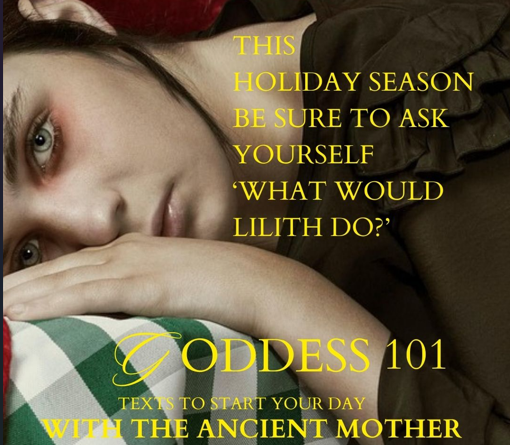
As we head into the Holiday season, a time when historically women took a break from their jobs and their housework to … coordinate and cook and take care of extended family at large gatherings, it’s important to ask yourself, ‘What Would Lilith Do?’
We all know Adam and Eve, but before Eve was Lilith.
And when Adam tried to dominate Lilith, she stood up and said, ‘yea, I don’t think so.’ And left.
For that, she was demonized as the baby-killer, vilified and otherwise subjugated throughout history in a slanderous attempt to keep women in their place.
Look there ain’t nothing wrong with being barefoot and pregnant. We happen to love both of those! But household obligations need to be split and balanced.
This holiday season, make sure you spend some time with your feet up relaxing.
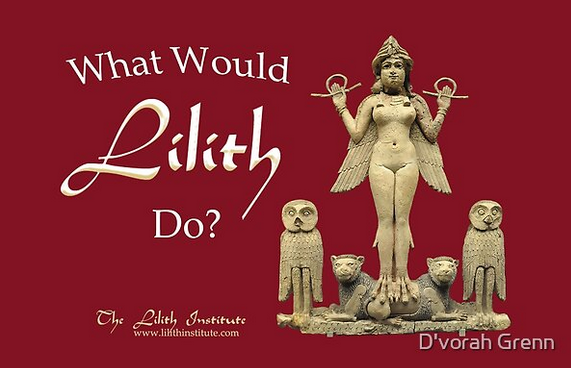
A Brief History of Lilith by D’vorah Grenn of Lilith Institute
The mythical figure of the ‘dark goddess’ Lilith—a symbol of the independent, rebellious, sensual, courageous, passionate, rageful potential in us all–has been as much a source of inspiration as she has been a flame igniting my curiosity since I was first introduced to her in 1985. For this, I thank an extraordinary teacher, Rabbi Bernard M. Zlotowitz of Hebrew Union College-Jewish Institute of Religion in New York.
According to Jewish legend, Lilith was Adam’s first wife and Eve’s predecessor. In the most commonly-told version of the tale, she is made from the earth, as is Adam. For this reason, she refuses to lie beneath Adam sexually, and when he insists, she mutters God’s secret name, leaves the Garden of Eden and Adam, and flies off to the Reed Sea [today called the Red Sea] to live her own life. After Adam complains to God about being alone and Eve comes into the picture, we learn—in traditional patriarchal recountings—that she is warned against the ‘evil’ Lilith and feels Lilith is a rival competing for Adam’s affections. In a contemporary feminist midrash or reinterpretation of this legend by Judith Plaskow, however, we see Lilith painted as Eve’s counterpart, confidante and friend (Womanspirit Rising, 1979).
Lilith is consistently portrayed in many cultures first as a demon, who might have been good or bad, then as a child-killer and temptress; as a woman embodying or representing the devil and often personified by Eden’s serpent. In literary and iconographic representations, she is clearly depicted as symbolizing the “evil” inherent in all women. Yet many contemporary women see in her the embodiment of the Goddess, Great Creatrix, Queen of Heaven and Earth, Goddess of Love and War, designations she shares with her counterparts Inanna, Ishtar, Asherah, Anath and Isis. As a goddess of love, beauty and things erotic she is akin to the Greek Aphrodite and the Roman Venus; in her wildness and thirst for justice she and Bhadra Kali, the Hindu goddess, could be thought of as sisters. The question of how bloodthirsty she may or may not be—and whether the role of avenger is a positive or negative one—remains an open one. There is also the question, which has gone largely unexplored, of the royal or divine status which may be signified by her serpentine crown and the rings she holds, usually recognized as symbolizing Sumerian royal authority. “She also holds the ring and rod of power. Thus she joins the first rank of gods” (Johnson, 1988).
Goddess Texts 101 are brought to you by the divine feminine app. Over ten years, the original source for finding Sacred Women Circles, events, retreats and resources. Sign up free, quick and easy to get a weekly email.

Picture credit: Image by niritaharoni62 from Pixabay

1 Comment