

By Caryn MacGrandle | The Divine Feminine App
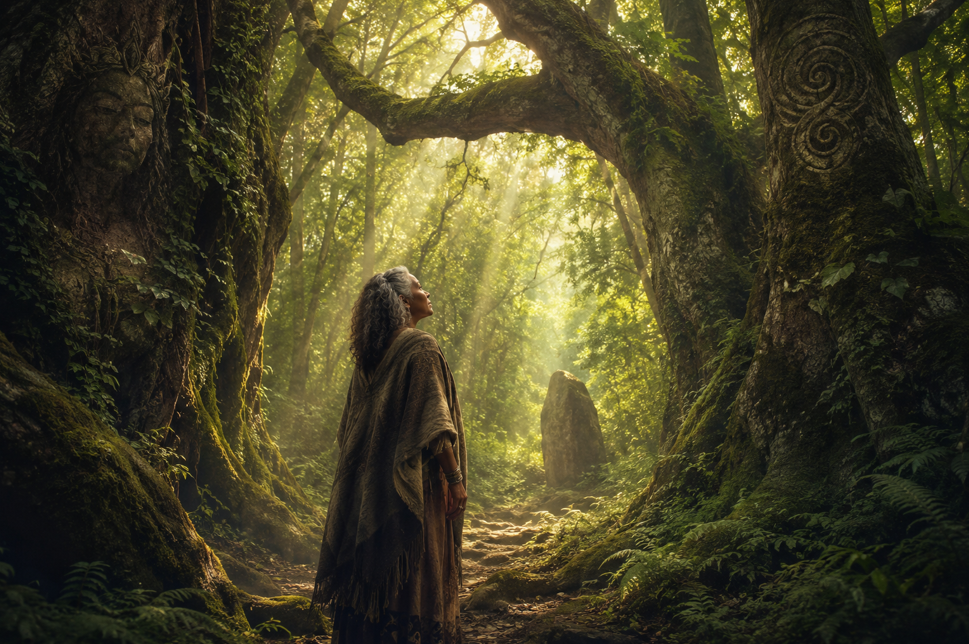
There is something that happens when you step into a forest.
The noise of the world falls away. The light changes — it filters down in shifting columns, green and gold, dappled by leaf and branch. Your breath slows. Something in your chest unclenches. You feel, without quite being able to name it, that you are in a place. Not just a location — a place. One that holds memory longer than you have been alive, that existed before you, and will continue after.
Our ancestors knew exactly what to call this feeling. They knew who was present in those trees.
Her name was Nemetona.
The Goddess of the Sacred Grove
Nemetona is the ancient British goddess of the sacred grove — and one of the most quietly powerful figures in the Celtic divine feminine pantheon. She was worshiped at Bath (the Roman Aquae Sulis), alongside Sulis, goddess of the healing thermal springs — two feminine powers presiding over two of nature’s most elemental gifts: water and forest.
In her artistic depictions, Nemetona appears as a seated queen, holding a scepter — an image of authority, calm, and rootedness. Around her stand three hooded figures, possibly attendants, spirits, or the triple aspect of the divine feminine. A ram accompanies her, symbol of strength and sacrifice.
She is not a goddess of dramatic battles or celestial fire. She is the goddess of sanctuary. Of threshold. Of the sacred space that the trees make when they grow together and the world outside grows quiet.
The Nemeton: Where Earth Became Sacred
The very word nemeton — from which Nemetona’s name derives — is an ancient Indo-European term for a sacred grove. These were not decorative gardens or pleasant hiking trails. They were the temples of the ancient world.
The nemeton was where communities gathered for rites of passage, seasonal ceremonies, healing work, and communion with the divine. In Ireland, these sanctuaries were called nemed or fidnemed — “forest shrine.” Across Celtic Europe and beyond, the sacred grove was the church, the courthouse, and the womb of spiritual life.
And womb is not a metaphor here. Ancient peoples understood sacred groves as uterine symbols — the literal body of the Mother Goddess made manifest in wood and root and soil. To enter the grove was to enter her. To be held. To be transformed.
These groves stretched across the ancient world:
- Drunemeton — in Asia Minor, the council place of the Galatian Celts
- Medionemeton — in Scotland
- Nemetodorum — in France
- Nemetobriga — in Spain
The grove-goddess archetype appears across cultures and languages. Asherah, the great Mother-Goddess of ancient Semitic tradition, was Lady of the Grove — her worship took place among trees, her sacred poles (asherim) planted in the earth. Diana Nemorensis — Diana of the Grove — presided over the wild wood at Lake Nemi in Italy. Brigit herself was associated with sacred groves and the flame kept alive in sacred forest clearings.
These are not coincidences. They are rememberings of something the human soul has always known: the forest is holy.
When the Groves Were Destroyed
As Christianity swept through Europe, one of its primary missions was the destruction of the nemeton.
Church councils issued repeated edicts against grove worship. Sacred trees were felled. Ancient sanctuaries were paved over or built upon. The goddesses who dwelled there were renamed, demonized, or forgotten entirely.
And yet — they persisted.
Folk memory held on. Certain trees remained “unlucky to cut.” Certain clearings stayed unfarmed, unnamed, untouched. People continued to bring offerings, tie cloths to branches, whisper prayers to roots. The reverence for the grove proved nearly impossible to fully suppress, because it does not live primarily in theology or doctrine. It lives in the body. In what happens to us when we walk among old trees.
The goddess who was driven underground did not disappear. She waited in the roots.
What Science Is Now Confirming
Here is something remarkable: the modern world is beginning to rediscover, through research and data, what our ancestors encoded in ritual and myth.
Forest bathing (shinrin-yoku, developed in Japan in the 1980s) has now been demonstrated to measurably reduce cortisol, lower blood pressure, boost immune function, and decrease anxiety and depression. Studies show that even brief exposure to forested environments improves mood, cognitive function, and feelings of awe and connection.
The Japanese researchers who named shinrin-yoku were not inventing something new. They were documenting something ancient.
What we feel in the forest — that sense of belonging, of being held, of breathing more deeply — is not imagination. It is our nervous systems remembering something true. We evolved among trees. We are, in the deepest sense, forest creatures. And the disconnection from wild nature that modern life enforces comes at a real, measurable cost to our bodies and souls.
Nemetona’s people knew this. They built entire spiritual traditions around it.
Bringing the Sacred Grove Back
So what does it look like, in our time, to honor Nemetona? To restore the nemeton?
It does not require a vast forest or a Celtic heritage. It requires intention. It requires the willingness to bring ceremony and reverence back to our time among the trees.
Here are some ways to begin:
Find your grove. This might be a forest trail, a park with old trees, a stand of pines at the edge of a field, the woods behind a friend’s house. It doesn’t have to be wild or remote. It has to be yours — a place you return to, regularly, with attention.
Arrive with intention. Before you enter, pause. Take a breath. Acknowledge that you are entering a sacred space. You might say her name — Nemetona — or simply bow your head in recognition. This act of transition is itself the ceremony.
Use all your senses. The sacred grove was never a place of pure mental prayer. It was embodied. Feel the ground beneath your feet. Touch the bark. Smell the decay and the green growth together. Listen to what the wind does in the canopy above you. Let your body do the remembering.
Leave an offering. This doesn’t need to be elaborate. A handful of dried herbs scattered on the roots. A few grains of cornmeal. A strand of your hair. Water poured at the base of an old tree. The act of giving something — even something small — shifts your relationship from visitor to participant. From tourist to devotee.
Create a regular ritual. The ancient groves were not visited once and forgotten. They were tended. Return to your grove at the turning points of the year — the solstices, the equinoxes, Samhain and Beltane. Notice what changes. Notice what stays the same. Let the seasons teach you.
Bring others. Sacred groves were community spaces. Gather a circle of women, a small family, a few friends. Sit together in the trees and speak honestly. Let the forest hold the conversation. You may be surprised at what becomes possible to say, and to hear, among the roots and branches.
A Living Tradition
The nemeton is not lost. It is waiting.
Every old-growth forest is a sacred grove in potential. Every stand of trees that has been allowed to mature, to breathe, to develop its understory and its canopy — every such place holds the presence that our ancestors honored with her scepter and her three hooded attendants.
Nemetona is not a historical curiosity. She is the spirit of every forest that remains. She is what you feel when you walk into the trees and your shoulders drop and you realize you had forgotten, again, what it feels like to be held by something larger than yourself.
She is the permission to stop. To be still. To recognize that you are not in an ornamental landscape — you are in a sanctuary.
We live in a time when forests are threatened, when our relationship with the natural world has become transactional and extractive, when many people can go months without spending meaningful time among trees. This is not just an ecological crisis. It is a spiritual one.
Reclaiming the sacred grove — bringing ceremony back to the forest, bringing reverence back to our time among the trees — is one of the ways we heal. Not just ourselves. But our relationship with the living world.
The goddess of the sacred grove is still there. She has always been there.
Go find her.
Nemetona is honored in the Hinneh Divine Feminine Library, the AI-powered sacred knowledge base of the Divine Feminine App. To explore her story and the stories of goddesses from around the world, visit thedivinefeminineapp.com.


2 Comments
Beautifully written and well thought out article. Thank you for reminding us to go outside and find Nematona.
Thank you for the read and comment. <3