Her birth name was Cynthia Ann Smith. Born on June 23, 1957, in Gibson City, Illinois, she never knew her biological parents. By the time she was about 18 months old, she had a new name, a new home, and a new life — with a kind, hardworking couple named Vernon and Noreen McDormand.
Vernon was a pastor from Nova Scotia with a very unusual calling. He did not stay in one place and build a church. He went where churches were dying. He would walk into a struggling congregation, rebuild its spirit, restore its finances, and then move on to the next one that needed saving.
It was beautiful work. But it meant the family never stopped moving.
Illinois. Georgia. Kentucky. Tennessee. Small town after small town across the American Bible Belt. Vernon and Noreen had no biological children of their own. Over the years they adopted and fostered around nine children. Three stayed permanently — Kenneth, Dorothy, and the little girl who had been renamed Frances.
Frances grew up as a child of borrowed communities. Always the new kid. Always learning how to walk into a room full of strangers and find her place. She didn’t know it then, but she was practising the most important skill of her life.
When the family finally settled in Monessen, Pennsylvania, Frances found something that would change everything. A high school play. A stage. And the terrifying, electric feeling of becoming someone else entirely.
She never let it go.
She earned a degree in theatre from Bethany College in West Virginia in 1979 — she was the school’s only theatre major. Then she went on to the Yale School of Drama, graduating with a Master of Fine Arts in 1982. It was there that she met a fellow student named Holly Hunter, and the two became close friends and roommates. When she moved to New York after graduation, she was broke, unknown, and full of a quiet, unmovable certainty.
New York was hard. She waited tables. She auditioned endlessly. She and Holly Hunter continued to share an apartment, and together they pushed through the rejection that comes for anyone brave enough to try.
Then, in 1983, two young filmmakers named Joel and Ethan Coen were casting their very first film — a low-budget, darkly atmospheric thriller set in Texas called Blood Simple. They had written the female lead with Holly Hunter in mind. Holly had just committed to another project and couldn’t take the role. But before she turned it down, she told the Coens about her friend Frances.
Frances auditioned. She got the part.
She was so new to film acting that she didn’t even know how to read a screenplay. But she showed up, she trusted the work, and she delivered. The film launched her career.
Blood Simple was released in 1984, and that same year Frances married Joel Coen.
Frances could have let that become her whole story — the director’s wife, the actress in her husband’s films. She refused. She worked with other directors. She returned to the stage again and again. She did television. She built a career that was entirely, stubbornly her own.
In 1988, she received her first Academy Award nomination — Best Supporting Actress for Mississippi Burning, in which she played the wife of a Klansman who finds the courage to help FBI investigators seeking justice in the American South. She didn’t win, but Hollywood took notice.
Then, in 1996, came the role that changed everything.
Joel and Ethan Coen wrote the character of Police Chief Marge Gunderson in Fargo specifically with Frances in mind. Marge was pregnant, soft-spoken, deeply intelligent, and completely unshakeable — a small-town Minnesota cop methodically untangling a kidnapping that had spiraled into multiple murders. It would have been easy to play Marge as comic or quirky. Frances played her as something rarer: a genuinely good person doing her job with patience, warmth, and absolute moral clarity.
At the 1997 Academy Awards ceremony, Frances McDormand won the Oscar for Best Actress.
She showed up in a simple dress with no Hollywood styling. She gave a short, grateful speech. Then she went home.
The nominations kept coming — Best Supporting Actress for Almost Famous in 2000, and again for North Country in 2005. She didn’t win either time. It didn’t slow her down.
In 2011, she won the Tony Award for Best Actress in a Play for Good People on Broadway. In 2015, she won her first Primetime Emmy Award for her stunning lead performance in HBO’s Olive Kitteridge. With the Tony, the Emmy, and the Fargo Oscar, she had achieved what the entertainment world calls the Triple Crown of Acting — one of the rarest achievements in the industry.
And still, she wasn’t finished.
In 2018, she won her second Best Actress Oscar, this time for Three Billboards Outside Ebbing, Missouri, in which she played a grieving mother refusing to let authorities forget her murdered daughter. The performance was fierce, raw, and unforgettable.
But it was what happened after she accepted that Oscar that the world still talks about.
She set the golden statuette on the stage floor beside her. She asked every female nominee in every category to rise to their feet. As the women stood, she looked out at the room full of Hollywood executives and said: “Look around, ladies and gentlemen, because we all have stories to tell and projects we need financed. Don’t talk to us about it at the parties tonight. Invite us into your office — or come to ours, whichever suits you best.”
Then she ended with two words no one in the room had heard before.
Inclusion rider.
She walked off the stage. The audience scrambled for their phones. What did that mean? An inclusion rider, it turned out, is a clause actors can write into their contracts requiring diversity in casting and production crew. Two words. No explanation needed. She left the idea like a seed in the room and let it grow.
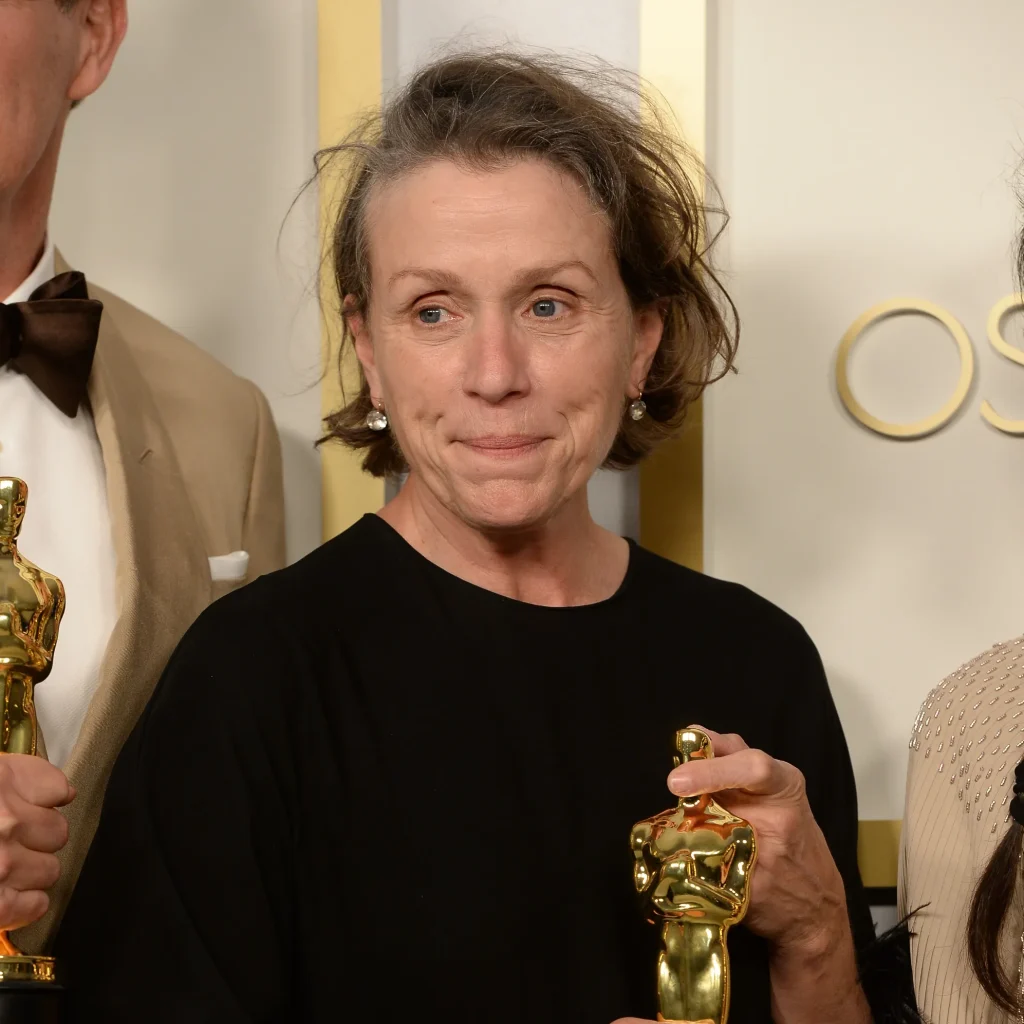
In 2021, she won her third Best Actress Oscar — for Nomadland, the quiet, extraordinary story of a woman living in a van, drifting through the American West after losing everything. Frances had also produced the film, and that same night she won Best Picture as one of its producers — holding two Oscars for the same film in the same evening.
She now has 4 Oscar statues in total — three for Best Actress, matching Katharine Hepburn’s all-time record for acting wins, plus one as a producer for Best Picture.
In 1995, she and Joel adopted a son, Pedro, from Paraguay. They brought him home as an infant. They raised him in New York, far from the spotlight, quietly and with great love — the same way Frances herself had been raised, passed into the arms of people who simply chose to show up.
Frances McDormand has been married to Joel Coen for over 40 years. She does not chase magazine covers. She has said she would like to disappear into an RV someday — which feels right, for a woman who spent her childhood in constant motion and her career in constant transformation.
She started life as Cynthia Ann Smith, a baby no one had planned for, carried from a stranger’s world into a pastor’s. She grew up in borrowed towns, learning to belong everywhere. She became an actress who could disappear into any human being — and come out the other side holding the truth of that life in her hands.
She won not by being the loudest person in the room, but by being the most present. Not by chasing fame, but by refusing to be anything less than fully, completely herself.
In a world that constantly tells women to be smaller, quieter, more convenient — Frances McDormand just keeps showing up. Exactly as she is. Exactly as she has always been.
And the world, eventually, always listens.

This post is part of Goddess 101 Texts – telling another side of Our Story.
Text ‘Join’ to 256-815-0760 to get your free daily dose of inspiration. *text Stop to stop at any time. Consent.
#Goddess101Texts a daily wake up call from Ancient Mom.

Use QR code above to text ‘Join’ plus your email to 256.815.0760 (Sorry for now, US only as International Texting is a thing, but you can see our monthly texts here and top right sign up to be notified of new blog posts from this site.)
Brought to you by the divine feminine app. Over ten years, the original source for finding Sacred Women Circles, events, retreats and resources. Sign up on the app to get a weekly email of Circles by you and online.