as found in The Double Goddess Women Sharing Power by Vicki Noble
“Vicki’s voice is unique and authentic in the women’s spirituality movement.” Olympia Dukakis
Research coming out of women’s studies, Native American studies, gender studies, and queer studies academic programs has significantly expanded the previous approaches taken to this kind of material. Obviously, if you are locked into a belief in only two rigid genders, which is conflated with heterosexuality as a divinely ordained state of being, then the gender fluidity implied in these studies will seem far-fetched and unlikely (or perhaps more to the point, unnatural). But for many of us arriving at this important historical moment the beginning of the twenty-first century these unorthodoxies are a great relief and resonate vividly with our lived and felt experiences. Similarly, the unearthing of skeletons and mummies of ancient women who obviously lived as warriors, priestesses, lesbians, and cross-dressing shamans is good news and very supportive of our need to invent ourselves with broader models than those offered by conventional mainstream culture.
In anthropological descriptions, women showing gender diversity have been noted as being larger and stronger than their “normal” sisters.
Crow Woman Chief was described as “taller and stronger than most women,” and others were said to have “often developed great strength. “9% A Bronze Age female mummy from Cherchen, in China, was six feet tall; and an Altai priestess unearthed from a frozen tomb discussed earlier was also taller than other women of her tribe, measuring in at five feet, six inches; but both of them were dressed as women with artifacts to show their roles as typically gendered women or priestesses.
In general in Central Asia, high-status women were often buried by themselves in large kurgans just like their male counterparts, the much-ballyhooed “chieftains” of the Bronze and Iron Ages. Davis-Kimball’s survey of Sauromatian and Sarmatian women living along the Volga River and of the mid-first millennium B.C.E. graves she excavated at Pokrovka (near Kazakhstan)-is illuminating. She shows that Iron Age women (like earlier Bronze Age Double Queens) functioned in specialized roles of warrior and priestess. Warrior women (fifteen percent of the women at Pokrovka) were buried with bronze and iron armaments, like their male counterparts (ninety-four percent of the men); priestesses (seven percent of the women) were buried with their own recognizable accoutrements: portable altars, mirrors, ancient seashells, boar’s tusk amulets, a spoon for the sacred fermented beverage, and often a crown, diadem, or headdress. 97
The majority of women in the burials (seventy-five percent) Davis-Kimball calls “hearth women.” They were buried at the center of their mounds seventy-two percent of the time, along with their spindle whorls and the other artifacts related to women’s more usual roles. Their central placement in the tombs shows women’s generally elevated status in these “matriarchal” tribal societies. 98 On occasion (three per-cent of the time), a particularly high-status or important woman (perhaps a third gender type) excavated from those burial mounds was buried with “both warrior and priestess artifacts,” leading Davis-Kimball to call such a woman a “warrior-priestess.”99
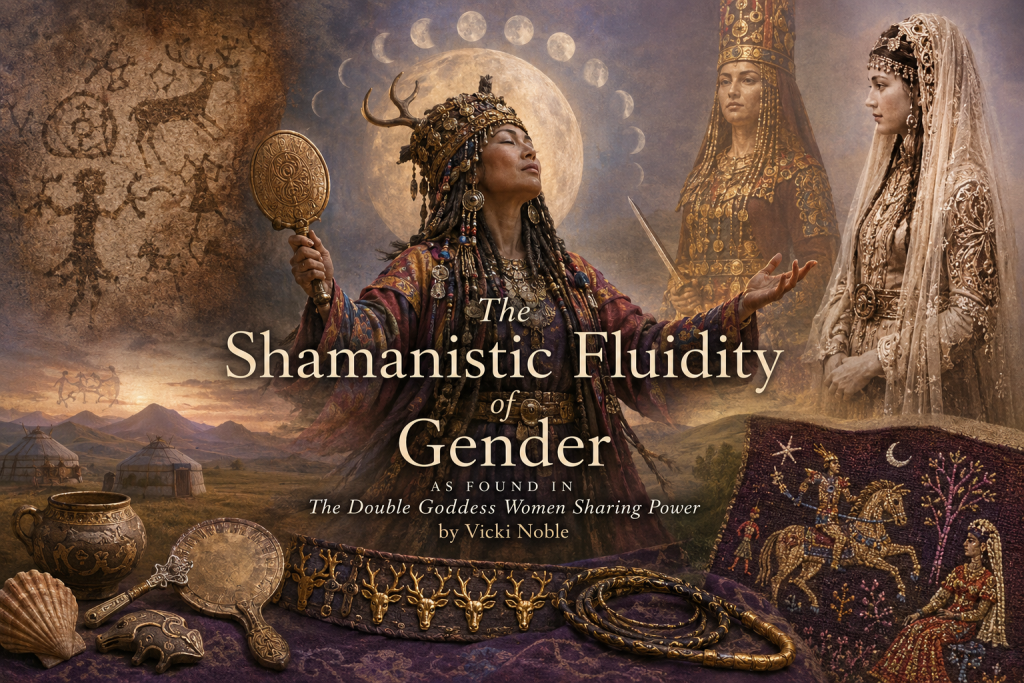
One such woman-potentially fitting the third gender type excavated by the Russians earlier in the twentieth century was mistakenly identified as a male warrior, a “young chieftain,” because of artifacts found in the grave. Through her insightful scholarly reconstruction, Davis-Kimball has clarified that the so-called “Gold Man of Issyk” was actually a Saka warrior-priestess; she was only five feet, three inches tall. (Saka tribes lived farther east near Mongolia and China, whereas Scythian and Sauro-Sarmatians lived west nearer to the Black Sea.) The fantastic burial contained weapons (short sword and dagger) and precious artifacts, including thousands of gold plaques sewn onto a caftan, jacket, and boots, and a gold-wrapped whip. The whip resembles those buried with Scythian women (see fig. 4.22 in chapter four) and Trojan-Yortan women before them (see fig. 4.21 in chapter four). A belt “accented with thirteen stylized gold deer heads” was made in the “lost-wax” casting method. 100 Thirteen is the female number par excellence, representing the actual number of Full Moons in a year.
But it was the unique headdress “suggestive of the images of shamans,” and some jewelry that had “never before been found in an early nomadic male’s burial” that caused Davis-Kimball to reexamine the burial from the standpoint of gender. She found that the tomb also contained “such telling artifacts as a gilded bronze mirror, a silver spoon with a bird’s-head handle, and a koumiss beater all of which have cultic significance.”101 She published her radical reframe of the burial in a 1997 Archaeology magazine, remarking on the “similarity of the Gold Man’s headdress to the traditional hats worn by Kazak brides.”102
This seems especially important, since I have concluded from my own research that the accoutrements of the priestess were often (perhaps always) transferred over to the bride, as matriarchal cultures gave way to patriarchal ones and women lost their former autonomy. Bridal costumes today in many different countries hold the key to the ancient priestesses’ functions. This hidden symbolic language is encoded in embroidery and weaving patterns, rather than in written text, and has therefore been ignored or missed altogether. I like to think that the reason contemporary women-even lesbians-love to put on those white dresses and veils and walk down that aisle is really because we remember in our cells that we were once the queens and priestesses of old.
Pg. 225 – 228
In honor of Pride Month – letting You be You